
India is a land where flavor is not just added—it’s layered, built, and celebrated. From the snowy peaks of Kashmir to the sun-soaked coasts of Kerala, Indian cuisine offers a taste for every tongue. But when it comes to the question, “Which is the tastiest food in India?”, the answer isn’t simple—it’s deliciously complicated.
Let’s embark on a flavorful journey and explore some of the dishes that hold the crown for being India’s most loved and tastiest foods.
🌶️ Taste in India: A Matter of Region, Tradition, and Emotion
Before we dive into specific dishes, it’s important to understand that taste in India is deeply personal and emotional. What’s considered the tastiest in one region might be completely unknown in another.
India’s diversity means:
- A dish can have five different versions across five states
- What one family eats for comfort, another might eat during festivals
- Taste is often linked to memories, rituals, and community
🥇 Top Contenders for the Tastiest Food in India
Let’s break down some of the most celebrated dishes across regions—each of them a contender for the title of “Tastiest Food in India.”
1. Hyderabadi Biryani (Telangana)

Hyderabadi Biryani isn’t just food—it’s heritage served on a plate. Known for its bold flavors, royal roots, and melt-in-your-mouth meat, this iconic dish is one of India’s most celebrated culinary treasures.
While biryani is made all across India, Hyderabadi Biryani holds a unique position for being both complex and comforting. It’s not just the taste—it’s the story behind it.
👑 A Royal Origin
Hyderabadi Biryani traces its roots to the Nizams of Hyderabad, who ruled one of India’s richest princely states. The dish is said to be a fusion of Mughlai and Deccani culinary traditions, perfected in the royal kitchens. It was designed to impress emperors—and today, it continues to impress millions across the world.
📝 Fun fact: The word “biryani” comes from the Persian word birian, meaning “fried before cooking.”
🔥 Dum Pukht – The Secret Cooking Method
The true essence of Hyderabadi Biryani lies in the “dum pukht” (slow steam) cooking technique, where:
- Meat is marinated in yogurt and spices
- Partially cooked basmati rice is layered on top
- The pot is sealed with dough and slow-cooked
- Spices infuse slowly, creating deep, aromatic flavors
This technique ensures that the meat is tender, the rice absorbs the flavor, and every spoonful is magical.
🍗 Two Main Types of Hyderabadi Biryani
1. Kacchi (Raw) Biryani
- Raw marinated meat is placed at the bottom
- Layered with partially cooked rice
- Sealed and cooked on low flame for hours
- Result: Juicy meat, flavorful rice with slightly different textures
2. Pakki (Cooked) Biryani
- Meat is cooked separately
- Fully cooked rice is layered on top
- Simmered together
- Result: Less risky, but slightly less complex in flavor than kacchi
📌 In Hyderabad, kacchi biryani is considered the gold standard for biryani lovers.
🌿 Key Ingredients
What sets Hyderabadi Biryani apart is the balance of spices and high-quality ingredients:
- Basmati rice (long-grained, aged)
- Goat or chicken meat (traditionally goat)
- Fresh herbs: mint, coriander
- Fried onions (adds sweetness and crunch)
- Yogurt-based marinade with ginger-garlic paste
- Saffron infused milk or kewra for aroma
- Ghee (clarified butter) for richness
🤤 Flavor Profile
Hyderabadi Biryani delivers a multi-dimensional experience:
- Starts aromatic and slightly sweet
- Quickly builds into a spicy, savory, and tangy note
- Ends with a cool, herbaceous finish
Each layer of rice tastes different—some spicy, some buttery, some fragrant—which keeps every bite exciting.
🏙️ Where to Eat Authentic Hyderabadi Biryani
If you’re ever in Hyderabad, here are some must-visit places:
- Paradise Biryani, Secunderabad – legendary and tourist-famous
- Bawarchi, RTC Crossroads – a local favorite
- Shah Ghouse Cafe – famous for midnight biryani
- Cafe Bahar – known for spicy, rich kacchi biryani
🧳 Pro Tip: Pair it with mirchi ka salan (green chili curry) and raita for the full experience.
🌍 Hyderabadi Biryani Goes Global
Today, you’ll find this dish:
- In Indian restaurants across New York, London, Dubai, and Singapore
- In frozen food aisles and YouTube cooking shows
- As a festive centerpiece during Eid, weddings, and Sunday feasts
It has crossed borders, religions, and classes—uniting people over a shared love for its rich, spicy goodness.
❤️ Why People Love It
- It’s flavorful but balanced
- It feels luxurious, even when eaten at a roadside stall
- It tells a story of culture, heritage, and home
Whether it’s your grandma’s slow-cooked pot or a takeaway box from a busy kitchen, Hyderabadi Biryani is a dish that makes people say,
“This tastes like home.”
2. Chole Bhature (Punjab/Delhi)

Fluffy. Spicy. Tangy. Crispy. Comforting.
There’s no dish quite like Chole Bhature. A breakfast that feels like a feast, a meal that’s equally at home in a roadside stall or a fancy restaurant—it’s one of North India’s most iconic and beloved dishes.
From the bustling lanes of Delhi to the dhabas of Punjab, Chole Bhature isn’t just food—it’s an emotion.
🧾 What Is Chole Bhature?
Chole = Spicy chickpea curry
Bhature = Deep-fried, puffed bread made from leavened dough
Together, they form a bold, flavorful, and filling dish, usually served with pickled onions, green chilies, and a spoonful of tangy tamarind chutney or raita.
🍴 The moment you tear open a hot bhatura and scoop up that thick, spicy chole—you know you’re about to taste something unforgettable.
🏛️ Where Did It Come From?
While its exact origin is debated, Chole Bhature is said to have emerged from Punjabi kitchens post-partition, gaining fame in Delhi’s bustling food scene.
Some trace its roots to Lahore (now in Pakistan), where spicy chickpeas and fried breads were common. Post-independence, refugees from Punjab brought it to Delhi, where it became a staple of North Indian street food.
🧡 Today, it’s loved across India—and even globally by the Indian diaspora.
🔥 Why Is It So Loved?
- Hearty & Satisfying: It’s not a snack; it’s a full-on meal
- Balanced Flavors: Spicy, tangy, crispy, soft—every bite has contrast
- Emotionally Tied: Often eaten on weekends, festivals, and holidays
- Easily Accessible: Found in 5-star hotels and street stalls alike
- Vegetarian but Bold: A rare vegetarian dish that feels meaty and rich
🌶️ Let’s Talk About the Chole
Chole (chickpea curry) is the soul of the dish.
Ingredients:
- White chickpeas (soaked overnight)
- Onions, tomatoes, ginger-garlic paste
- Spices: garam masala, cumin, coriander powder, chili, turmeric
- Black tea or amla (gooseberry) for deep color
- Fresh coriander to finish
🧂 Some versions even add crushed pomegranate seeds or chaat masala for a tangy punch.
The best chole is:
- Thick and masala-rich
- Spicy, but balanced
- Slightly sour (from anardana or amchur)
🍞 Let’s Talk About the Bhature
The bhature is the showstopper—a giant, puffed, golden bread that’s crispy outside and soft inside.
How It’s Made:
- Maida (refined flour)
- Yogurt or curd (for fermentation)
- Baking soda or yeast
- Sometimes stuffed (with paneer, potatoes, or lentils)
It’s rolled and deep-fried till it balloons like a golden cloud.
🥵 The moment it hits hot oil, magic happens. And nothing beats a freshly fried bhatura!
🏙️ Best Places to Eat Chole Bhature
If you’re ever in North India, these legendary places serve some of the best:
- Sita Ram Diwan Chand (Delhi – Paharganj)
Famous for tangy chole and soft bhature. - Chache Di Hatti (Delhi – Kamla Nagar)
Iconic spot with long queues. Their green chutney is a game-changer. - Amritsari Kulcha Land (Amritsar)
While known for kulchas, their chole bhature combo is unbeatable. - Punjabi By Nature (Pan-India)
For a gourmet version of this street food classic.
🧠 What Makes It So Addictive?
- Texture Contrast – Crunchy onions, soft bhature, thick gravy
- Flavor Layering – Spices + tang + oil + freshness = explosive combo
- Emotional Nostalgia – Most Indians associate it with Sunday brunches or special days
- Social Food – Meant to be shared with friends or family
🌍 Chole Bhature Around the World
Thanks to Indian restaurants across the globe, Chole Bhature has gone international:
- In London, it’s served with tamarind foam and microgreens
- In Toronto, you’ll find vegan versions with jackfruit
- In Dubai, it’s paired with mango pickle and lassi
- In New York, it’s been reinvented as a “Bha-taco” (bhatura taco shell!)
🥗 It’s even been adapted as a street-style slider—with chole between mini bhaturas!
🥄 Variations Worth Trying
- Paneer Bhature – Bhatura stuffed with paneer
- Methi Bhature – Slightly bitter but fragrant, made with fenugreek
- Kulcha-Chole – Similar, but kulchas are baked, not fried
- Mini Bhature – Party-size versions that make perfect snacks
3. Masala Dosa (Karnataka)

Crispy. Golden. Savory. Soul-satisfying.
When you think of South Indian breakfast, Masala Dosa is the undisputed king. This iconic dish from Karnataka has not only taken over India but has also made its mark on breakfast menus across the globe.
But Masala Dosa is more than just a dish—it’s a culinary experience that starts with a sizzle and ends with satisfaction.
📜 Origins: A Bite of South Indian History
While dosas have been mentioned in ancient Tamil and Kannada literature as early as the 1st century, Masala Dosa as we know it today originated in Udupi, Karnataka.
Udupi is not just a place—it’s the spiritual and culinary heartland of South India. The dosa was born as a simple rice-lentil crepe, but the “masala” (spiced potato filling) was added later, possibly as a way to make it a more filling meal during the early 20th century.
🧘 Udupi cuisine is deeply tied to temple culture—purely vegetarian, simple, yet rich in flavor and tradition.
🔍 What Exactly Is a Masala Dosa?
- Dosa: A thin, crispy crepe made from fermented rice and urad dal (black lentils).
- Masala: A mildly spicy potato-onion filling, usually flavored with mustard seeds, curry leaves, turmeric, and green chilies.
It’s typically served with:
- Coconut chutney (cool and creamy)
- Tomato chutney (tangy and spicy)
- Sambar (a lentil-vegetable stew that adds warmth and balance)
🥄 Eating masala dosa is an interactive experience—dip, mix, break, scoop, savor.
🔬 The Art of the Perfect Dosa
A well-made Masala Dosa is a textural masterpiece:
- Crispy edges
- Slightly soft center
- Thin and lacy, yet sturdy enough to hold the masala
The batter is fermented for 8–12 hours to develop natural sourness, which gives the dosa its unique tang and helps in digestion.
The dosa is cooked on a cast iron tawa or non-stick griddle, often with a touch of ghee or oil that crackles on contact, filling the kitchen with an irresistible aroma.
🌱 Why It’s a Balanced Meal
Masala Dosa isn’t just delicious—it’s also nutritionally smart:
- Fermented batter = good for gut health
- Urad dal + rice = complete protein
- Potato filling = energy-rich carbs
- Coconut chutney & sambar = healthy fats + fiber + antioxidants
🍽️ A complete, wholesome vegetarian meal that’s loved by nutritionists and foodies alike.
🏙️ Best Places to Eat Masala Dosa in Karnataka
If you’re in Karnataka, you’re never far from dosa heaven. Here are legendary spots:
- CTR (Central Tiffin Room), Bengaluru
Known for thick, buttery benne (butter) masala dosas with a cult following. - MTR (Mavalli Tiffin Rooms), Bengaluru
Heritage restaurant serving dosas with ghee and nostalgia. - Hotel Janatha, Basavanagudi
A no-frills spot that’s dosa royalty for locals. - Udupi Sri Krishna Bhavan, Udupi
Traditional Udupi-style dosa straight from the birthplace.
🥇 Every region in Karnataka has its own twist—some thicker, some thinner, some folded like a paper fan.
🌍 Global Fame: Masala Dosa Across the World
From London brunch cafés to NYC vegan restaurants, Masala Dosa has earned international respect. It’s:
- Gluten-free
- Vegan-friendly
- Easily customizable (cheese dosa, onion dosa, paneer dosa, etc.)
It’s now being reimagined as:
- Dosa tacos
- Dosa wraps
- Mini dosa bites for cocktail parties
📦 Frozen dosa batters and instant mixes are exported worldwide to meet demand.
🔄 Variations to Try
- Mysore Masala Dosa – With a spicy red chutney spread inside
- Paper Dosa – So thin and large it barely fits on the plate
- Set Dosa – Thick, soft dosas served in stacks, usually without stuffing
- Rava Dosa – Made from semolina, instantly crisp, no fermentation
- Cheese Masala Dosa – A modern twist that kids (and adults) love
🧠 Why It’s a Cultural Icon
- It brings generations together—grandparents and children both love it.
- Affordable luxury—served in 5-star hotels and roadside tiffin stalls alike.
- Ritualistic—Sunday mornings, weddings, train journeys, temple visits.
It’s not just a dish—it’s an identity, especially for people from Karnataka.
4. Rogan Josh (Kashmir)

Elegant. Deep. Warming. Royal.
Rogan Josh is not just a dish—it’s the heartbeat of Kashmiri cuisine. In a land known for snow-covered mountains, saffron fields, and silk carpets, this slow-cooked mutton curry stands out as a symbol of warmth, hospitality, and heritage.
If food could tell stories, Rogan Josh would speak in poetry—of emperors, Persian influence, and the rich soul of Kashmir.
📜 The Royal Origins of Rogan Josh
The name “Rogan Josh” comes from Persian:
- “Rogan” = oil or clarified butter
- “Josh” = intense heat
Together, it signifies a dish cooked in oil over high heat, using rich, aromatic spices. It was introduced to India by the Mughals, who brought their love for Persian flavors into the cold valleys of Kashmir. Over time, it was adapted by the Kashmiri Pandits, who gave it a unique identity by using no onion or garlic but focusing on subtle, earthy flavors.
👑 Today, it is a centrepiece in the traditional Wazwan, a lavish Kashmiri multi-course meal served at weddings and festivals.
🥘 What Exactly Is Rogan Josh?
At its core, Rogan Josh is a braised lamb or mutton curry, deeply infused with:
- Kashmiri red chilies (which give it color, not excessive heat)
- Yogurt (for body and tang)
- Dry ginger and fennel (key to its signature Kashmiri aroma)
- Mustard oil or ghee (to bring the flavors alive)
- Cardamom, cinnamon, and bay leaf (for a subtle, warming fragrance)
The result? A dish that is vibrant red, subtly spicy, and soulfully aromatic.
🌶️ Unlike other spicy Indian curries, Rogan Josh is refined and balanced, never overwhelming.
🔍 What Makes Rogan Josh Unique?
1. Color Without Fire
It gets its beautiful red hue from Kashmiri red chilies, which are low in heat but rich in color—giving the dish a luxurious look without burning your palate.
2. Minimalism with Depth
Despite using fewer ingredients compared to other Indian curries, the dish achieves incredible complexity through long, slow cooking.
3. Kashmiri Flavor Palette
You’ll taste no onion, tomato, or garlic in traditional versions—just yogurt, dry spices, and the magic of slow simmering.
4. Meat is King
Rogan Josh honors the meat—it’s never drowned in gravy. The mutton is the hero, and every spice is there to enhance, not overpower.
🍽️ How It’s Traditionally Cooked
The traditional process is slow and intentional:
- Mutton is seared in hot oil or ghee, sealing in the juices
- Spices like bay leaf, cinnamon, cloves are added for aroma
- Yogurt is beaten and added slowly to avoid curdling
- Dry ginger and fennel powder bring a distinct Kashmiri character
- Simmered for hours, allowing the flavors to deepen and the mutton to become tender
🪔 Traditionally cooked in heavy copper pots (called deg), over a wood-fired stove.
🗺️ Variations Across India
While the authentic Kashmiri version is subtle and refined, several variations exist:
- Punjabi Rogan Josh – Heavier on onions and garlic, spicier
- Restaurant-Style Rogan Josh – Often redder and richer, with more oil or tomato
- Modern Fusion Rogan Josh – Sometimes served as a pulled meat filling for buns or tacos!
🔥 But purists believe nothing beats the slow-cooked, saffron-scented, traditional Kashmiri version.
🧡 Cultural Significance
Rogan Josh is more than food—it is ceremony and identity for Kashmiris:
- Served at weddings, religious feasts, and special occasions
- Central to Wazwan, the traditional 36-course meal
- A point of pride for both Kashmiri Muslims and Kashmiri Pandits
✨ To be served Rogan Josh in a Kashmiri home is to be welcomed with love and honor.
🍷 Perfect Pairings
- Served with: Steamed rice, saffron pulao, or Kashmiri naan
- Drinks: Kahwa (saffron tea) or a mild lassi
- Sides: Simple cucumber raita or chutney
🌍 Rogan Josh Goes Global
- Found in Michelin-starred Indian restaurants around the world
- Popular in Britain (especially with the Indian diaspora)
- Reimagined in food festivals, fusion pop-ups, and gourmet meal kits
🥘 You’ll even find Rogan Josh simmer sauces on grocery shelves in Australia, the UK, and the U.S.
5. Pani Puri (Pan-India)

Crunchy. Spicy. Tangy. Refreshing. Addictive.
Few foods in India command the kind of emotional loyalty and cult following that Pani Puri does. Whether you call it Golgappa, Puchka, Gupchup, or Pani ke Batashe, it’s one of India’s most loved and unifying snacks.
From the roadside vendors of Mumbai to the busy streets of Kolkata, from school kids to grandparents—everyone has a pani puri memory, a favorite stall, and a personal spice tolerance.
🌍 A National Treasure With Many Names
| Region | Name |
|---|---|
| Maharashtra, Gujarat | Pani Puri |
| Delhi, Punjab, Haryana | Golgappa |
| Bengal, Bihar, Jharkhand | Puchka |
| Odisha, Chhattisgarh | Gupchup |
| UP, MP | Pani ke Batashe |
🧠 Each name comes with slight variations in ingredients, spice levels, and flavor—but the essence remains the same: a hollow crisp filled with joy.
🛠️ What Is Pani Puri Made Of?
At its core, Pani Puri is a combination of five components:
- Puri: A hollow, deep-fried, crispy shell made of semolina or wheat flour.
- Filling: Usually spiced mashed potatoes, white peas, or sprouted moong.
- Pani (Flavored Water): Tangy, spicy, minty, and chilled. Made with tamarind, mint, coriander, green chili, cumin, and black salt.
- Sweet Chutney: A tamarind-jaggery mix to balance the spice.
- Garnish: Sev, coriander, onion, or a drop of lemon (depending on region).
🍴 To eat it: Crack the top of the puri, stuff in the filling, dip it in pani, and pop it whole into your mouth.
💥 The Flavor Explosion
One bite of pani puri gives you:
- Crunch from the puri
- Creaminess from mashed potatoes
- Heat from green chili
- Tang from tamarind
- Coolness from mint water
It’s a one-shot sensory overload—the Indian version of a flavor bomb.
📍 Regional Twists & Styles
1. Mumbai-Style Pani Puri
- Filling: Ragda (white peas)
- Pani: Minty and tangy
- Often followed by sukha puri (a dry version with chutneys only)
2. Delhi Golgappa
- Filling: Spiced mashed potatoes
- Pani: Slightly sweet and sour
- Often served chilled with boondi in the water
3. Bengali Puchka
- Filling: Mashed potatoes mixed with black salt, chili, tamarind
- Pani: Spicier and thinner
- More intense and flavorful, usually eaten at lightning speed
4. UP/Bihar Style
- Filling: Black gram (chana) or mashed aloo
- Pani: Sweet-sour, sometimes with a hint of hing (asafoetida)
- Sold in steel trays with perfect rhythm by vendors
🌶️ Every region claims their version is the best—and honestly, they all have a point.
🛒 Street Food Culture & Ritual
Eating pani puri isn’t just a snack—it’s an experience:
- Served one-by-one by the vendor
- You eat while standing at the cart
- You give a subtle nod or say “ek aur!” for the next one
- Some people challenge friends for “who can eat more”
- Others request “extra spicy” or “sweet pani only“
🧍♀️ The best pani puri is eaten with strangers standing beside you, with sweat on your brow and spice on your lips.
😋 Why Is It So Addictive?
- Contrast of textures: Crisp shell + liquid center
- Burst of flavors: Sour, sweet, salty, spicy—all at once
- Cheap and cheerful: Pocket-friendly and widely available
- Satisfying yet light: You can eat 6–8 without feeling heavy
- Social: Always eaten with friends or family
🌀 It’s food you don’t eat slowly—you chase the next bite before the first is fully processed.
🌎 Global Rise of Pani Puri
- Fusion dishes: Vodka pani puri, chocolate puri, cheese-filled versions
- Upscale versions: Served on tasting spoons at Michelin-star restaurants
- Food challenges: Viral on YouTube, TikTok, and Instagram
- Packaged kits: Available in stores across the US, UK, and UAE
🍸 You’ll now find pani puri in fine dining menus, fusion buffets, and cocktail parties—but nothing beats the roadside version.
🧠 Cultural Significance
- For many Indian girls and women, it’s a go-to evening snack outing with friends
- Families bond over pani puri counters during weddings and vacations
- Every city has its legendary pani puri vendor—and that vendor is a local hero
- It’s often the first street food experience people remember from childhood
6. Fish Curry with Rice (Kerala/Bengal/Goa)
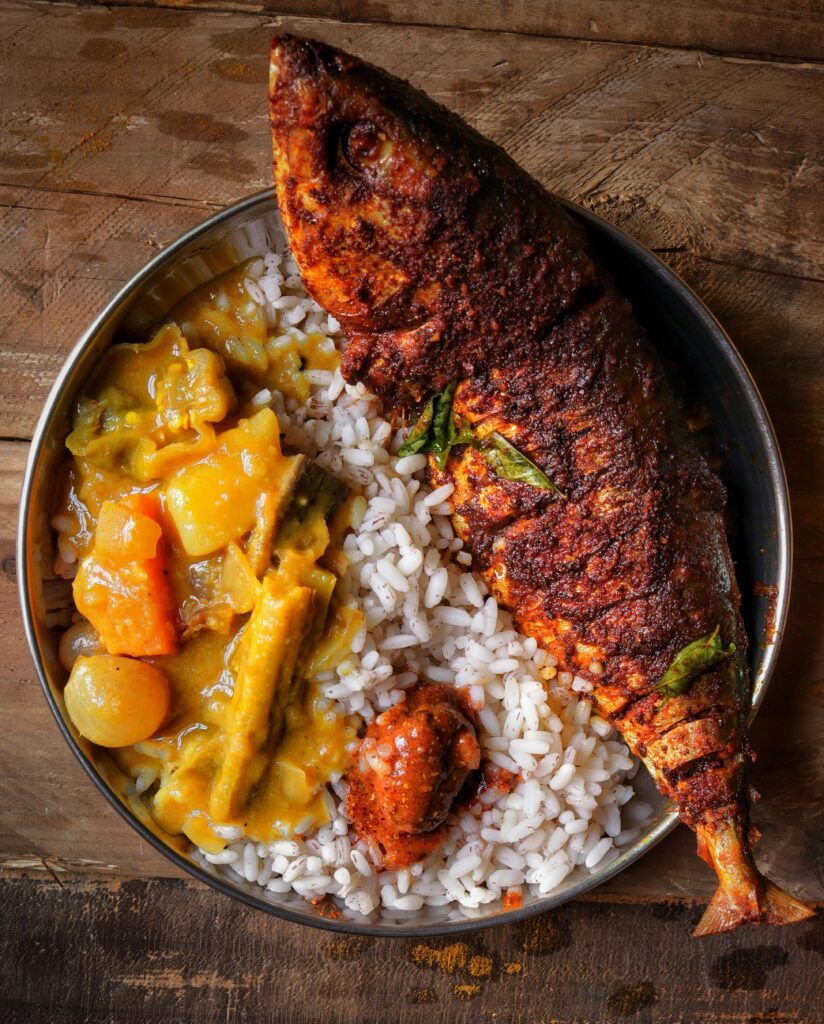
Fish curry with rice isn’t just a dish—it’s a feeling. A comfort meal. A celebration of the sea. And across India’s long, fish-loving coastline, this humble combination becomes a masterpiece of regional identity, culture, and spice.
From the coconut-rich shores of Kerala, to the mustard-laced kitchens of Bengal, to the Portuguese-flavored plates of Goa—fish curry with rice takes on unique, delicious forms.
🌴 Kerala: Meen Curry with Steamed Matta Rice
Signature flavors: Coconut, curry leaves, tamarind (kudampuli), mustard seeds, and green chilies
In Kerala, “meen curry” (meen = fish) is a staple. It’s commonly made with seer fish, pearl spot (karimeen), or sardines and served with red matta rice.
Key Features:
- Cooked in earthen pots (chatti) for a rustic, smoky flavor
- Uses coconut oil and often grated or ground coconut
- Tamarind or kudampuli (Malabar tamarind) adds sourness
- Tempered with mustard seeds, garlic, curry leaves, and shallots
Must-Try Version:
Kerala-style Nadan Meen Curry – A fiery red, slightly tangy curry with thick gravy that gets better as it rests overnight.
🍛 Best paired with: Matta rice, kappa (tapioca), or appam
🐟 Bengal: Shorshe Maachh (Mustard Fish Curry) with Bhaat
Signature flavors: Mustard paste, nigella seeds (kalonji), mustard oil, and green chili
Bengal’s deep love for fish and rice (maachh-bhaat) is legendary. The fish, often rohu (rui), katla, or ilish (hilsa), is revered.
Key Features:
- Cooked in cold-pressed mustard oil for pungent aroma
- Ground yellow or black mustard seeds form the base
- Often served light and soupy (jhol) or thick (kaliya)
- Mild spice but rich depth of flavor
Must-Try Version:
Shorshe Ilish – Ilish (hilsa) cooked in a mustard and green chili paste. Soft, flaky, rich, and served with plain steamed rice.
🥄 Best paired with: Hot rice and maybe a squeeze of lime
🏖️ Goa: Xitti Kodi (Goan Fish Curry) with Steamed Rice
Signature flavors: Coconut milk, kokum, Goan red chilies, garlic, and vinegar
Goa’s fish curry is a bright orange, soul-warming dish usually made with mackerel, kingfish, pomfret, or prawns.
Key Features:
- Coconut milk or paste forms the base
- Sourness from kokum or vinegar
- Fiery heat from Kashmiri or Goan red chilies
- Spices are roasted and ground fresh—a labor of love
Must-Try Version:
Goan Prawn Curry – Rich, slightly tangy with coconut milk, served with fluffy rice and fried fish on the side.
🍤 Best paired with: Steamed rice, sol kadi, and maybe a cold drink on the beach
🧭 South vs. East vs. West – How Do They Differ?
| Region | Kerala | Bengal | Goa |
|---|---|---|---|
| Base | Coconut, tamarind | Mustard paste, mustard oil | Coconut milk, kokum |
| Fish | Karimeen, sardines | Hilsa, rohu, katla | Kingfish, prawns, mackerel |
| Spice | Medium to high | Mild to medium | Medium, tangy |
| Oil | Coconut oil | Mustard oil | Neutral or coconut |
| Sourness | Tamarind or kudampuli | Natural from mustard | Vinegar or kokum |
👩🍳 The Cultural Role of Fish Curry
- In Bengal, fish is sacred—served at weddings, festivals, and daily meals
- In Kerala, it’s part of every second meal—fish curry is medicine, they say
- In Goa, it’s beach food, soul food, and celebration food—all in one
🎶 It’s not just sustenance, it’s a deep-rooted culinary tradition passed down through generations
🌾 The Magic of Rice + Fish
Fish curry without rice? Unthinkable.
Each region pairs the curry with its local rice:
- Matta rice (Kerala) – nutty, earthy, and filling
- Gobindobhog/Basmati (Bengal) – fragrant, delicate
- Short-grain steamed rice (Goa) – fluffy and neutral to absorb flavor
🍴 Why It’s Among India’s Tastiest Dishes
- Comfort food across the coasts
- Deeply flavorful yet simple
- Endless variations across fish types and spice levels
- Great balance of protein, carbs, fat, and flavor
“It’s the kind of dish that feels like a warm hug after a long day.”
🏆 So… Which Is the TASTIEST?
The honest answer is: it depends on your taste buds and your roots.
But based on popularity, diversity, and universal appeal, here are the top 3:
| Rank | Dish | Why it wins hearts |
|---|---|---|
| 🥇 1 | Hyderabadi Biryani | Complex, festive, iconic across regions |
| 🥈 2 | Masala Dosa | Crispy, wholesome, loved across India and abroad |
| 🥉 3 | Chole Bhature | Comforting, rich, and emotionally nostalgic |
🍽️ Final Thoughts
In India, taste isn’t just about flavor—it’s about memory, story, and tradition. Whether it’s the biryani shared at a wedding, the dosa on a lazy Sunday morning, or pani puri after school—each dish becomes a tastiest food in someone’s story.
So next time someone asks, “What is the tastiest food in India?” — you can say:
“It depends on where you are, but it will always be unforgettable.”